How Customer Success Operations Drives Revenue
CS Ops: How Customer Success Operations Drives Retention and Revenue?
Written By
Riddhima Parkar
Posted On
CS Ops: How Customer Success Operations Drives Retention and Revenue?
Customer success work is not only about customer calls, QBRs, and renewal conversations. A large part of the work depends on systems, workflows, data, and reporting that keep the team organized.
That behind-the-scenes function is called CS Ops, short for Customer Success Operations. It is the operational layer that supports customer success teams by organizing processes, managing tools, and turning customer data into clear, usable information.
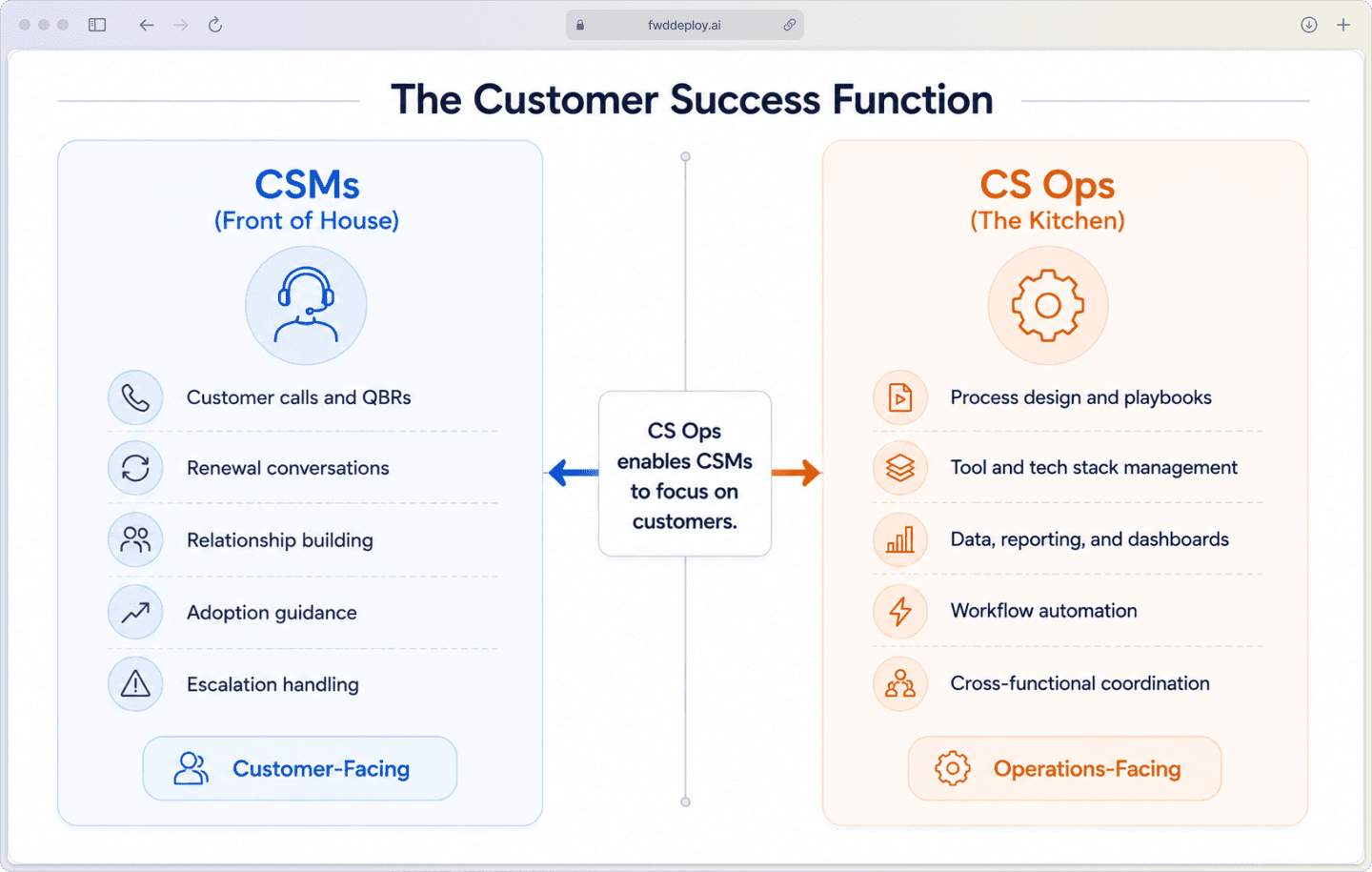
Think of it this way: CSMs are the front-of-house team building customer relationships. CS Ops is the kitchen, running systems, doing prep work, and coordination that ensures consistency.
No jargon-heavy theory here. We'll walk you through what CS Ops actually is, what it does, and why it directly affects retention and revenue.
What is CS Ops?
CS Ops is the operational backbone that supports and scales the entire customer success team. It handles the process design, data management, tool administration, and cross-functional coordination that CSMs rely on to do their jobs well.
Without it, CSMs spend time updating records and pulling manual reports. This time could go toward customer conversations instead.
CS Ops typically covers four areas:
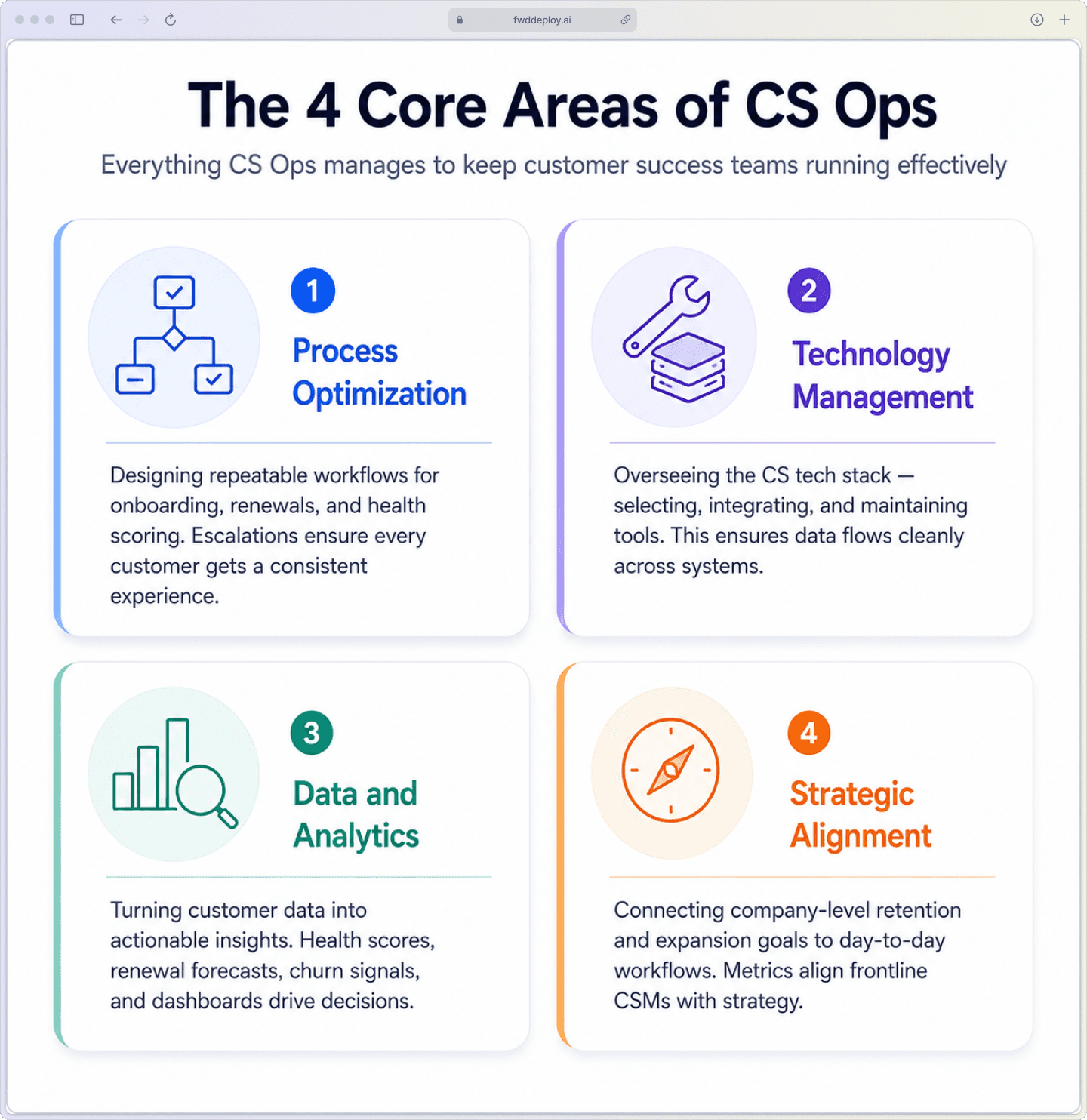
Process optimization: Designing workflows for onboarding, renewals, and health scoring
Technology management: Overseeing the CS tech stack so tools work together
Data and analytics: Providing actionable insights and forecasting to leadership
Strategic alignment: Connecting executive strategy to day-to-day execution
Why CS Ops matters for customer success teams
As the customer base grows, complexity grows with it.
More accounts, more renewal dates, more product usage data, and more service issues create a volume of information that is difficult to manage without structure.
CS Ops removes that friction. It organizes workflows, standardizes handoffs, and keeps data accessible. Teams spot risks earlier and act before problems escalate.
The shift this creates is significant: customer success moves from reactive to proactive. Instead of responding after a renewal is already in danger, teams can act on warning signs before the conversation gets difficult.
How CS Ops drives customer retention and revenue growth
CS Ops affects retention by making customer work more consistent and easier to track. When onboarding steps, health signals, renewal dates, and risk alerts are organized, fewer accounts fall through the cracks.
Churn often starts with small problems that go unnoticed. Delayed onboarding, low usage, and unresolved issues create risk. CS Ops creates systems that detect those signals earlier, giving teams a clearer view of which accounts are stable and which are drifting.
The connection to revenue is direct:
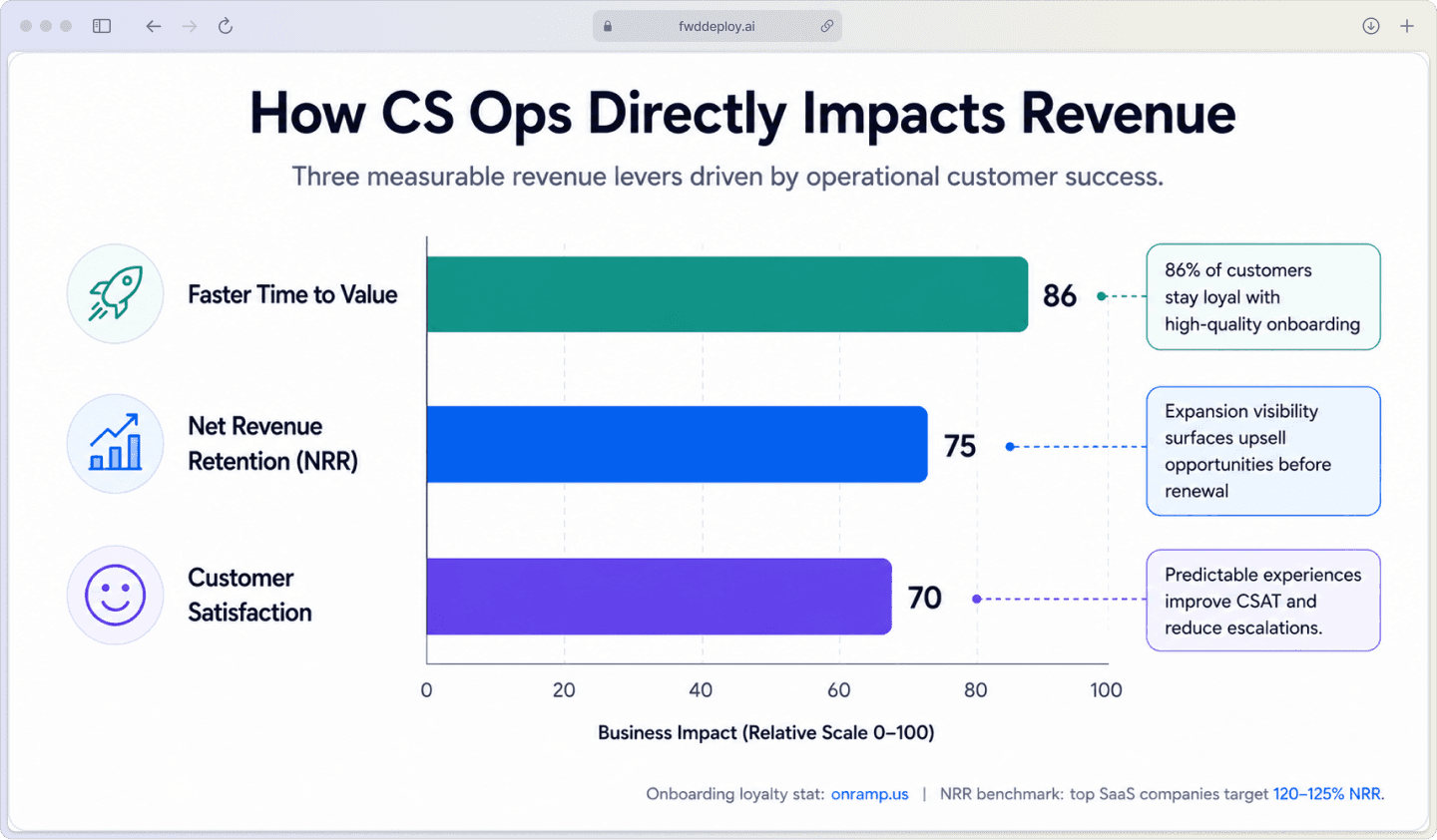
Faster time to value: Customers who complete onboarding quickly are more likely to renew; 86% remain loyal when onboarding is high quality.
Net Revenue Retention (NRR): Organized expansion visibility surfaces upsell opportunities before renewals.
Customer satisfaction: Predictable experiences improve CSAT and reduce escalations.
The five pillars of customer success operations
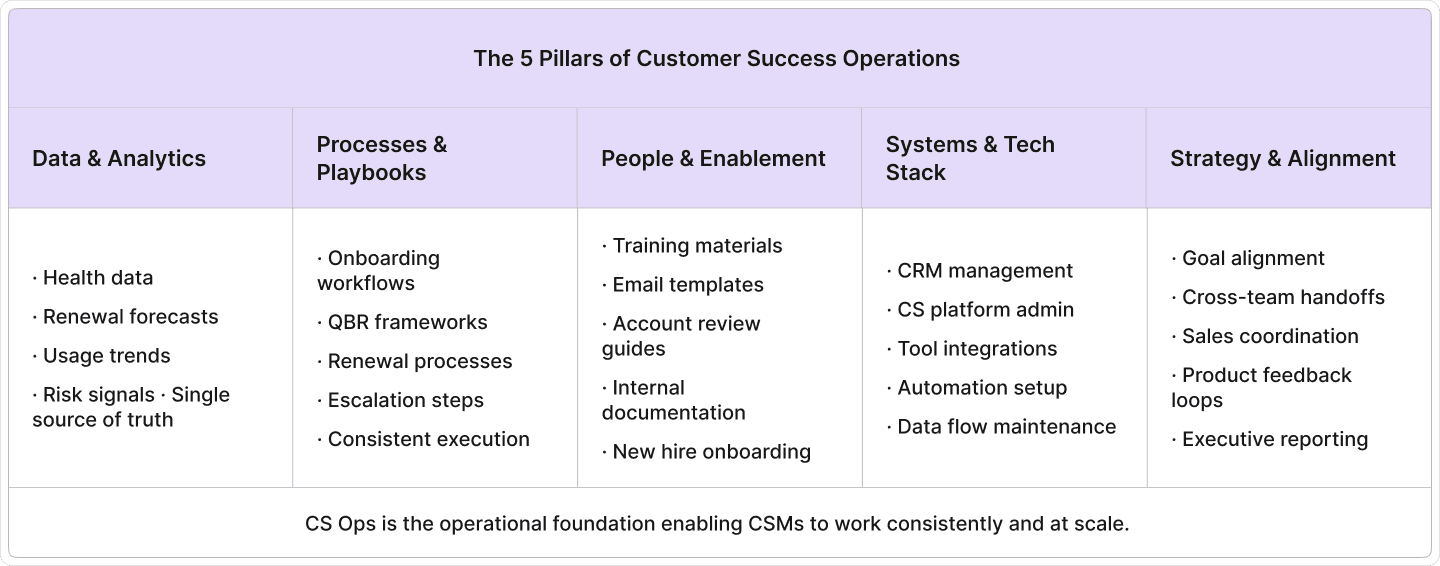
Effective CS Ops rests on five core areas. Each one covers a different part of how a customer success team works, measures progress, and stays aligned.
Data and analytics
This pillar covers the information a team uses to understand account status and performance. It includes customer health data, reporting dashboards, renewal forecasts, usage trends, and account-level risk signals.
The goal is a single source of truth, one reliable system. Leadership, managers, and CSMs view the same data instead of comparing conflicting numbers.
Processes and playbooks
This pillar focuses on repeatable ways of working across the customer journey, standardized workflows for onboarding, QBRs, renewals, escalations, and risk reviews.
A playbook shows what actions to take, when to take them, and what information to capture at each stage. Playbooks help create consistent customer experiences regardless of which CSM owns the account.
People and enablement
This pillar covers the resources that help CSMs work accurately and consistently, training materials, email templates, account review frameworks, and internal documentation.
Clear documentation reduces guesswork. New team members follow the same standards from day one.
Systems and tech stack
CS Ops manages the tools that support customer success work, selecting, connecting, maintaining, and optimizing them across the team. A typical CS tech stack includes a CRM, a customer success platform, communication tools, and reporting software.
Disconnected tools cause lost context, duplicate work, and outdated records. CS Ops keeps the stack connected.
Strategy and alignment
This pillar connects company goals to frontline workflows and metrics. It coordinates work across sales, product, support, and marketing.
What a customer success operations manager does
A Customer Success Operations Manager handles systems, planning, and coordination. The role blends analysis, process design, and team support.
Here is what the role typically covers:
Technology stack management: Selecting, integrating, and tuning tools so data flows cleanly.
Program strategy and execution: Designing onboarding, adoption, and renewal programs with clear ownership.
Cross-functional alignment: Organizing handoffs with sales, product, and support teams.
Data and insights management: Building dashboards, churn reports, and health models for leadership and CSMs.
CSM enablement and playbooks: Creating templates, guides, and training materials for consistent execution.
Operational efficiency and automation: Automating renewal reminders, health alerts, and lifecycle updates to focus CSM time on customers.
Signs your team needs a CS Ops function
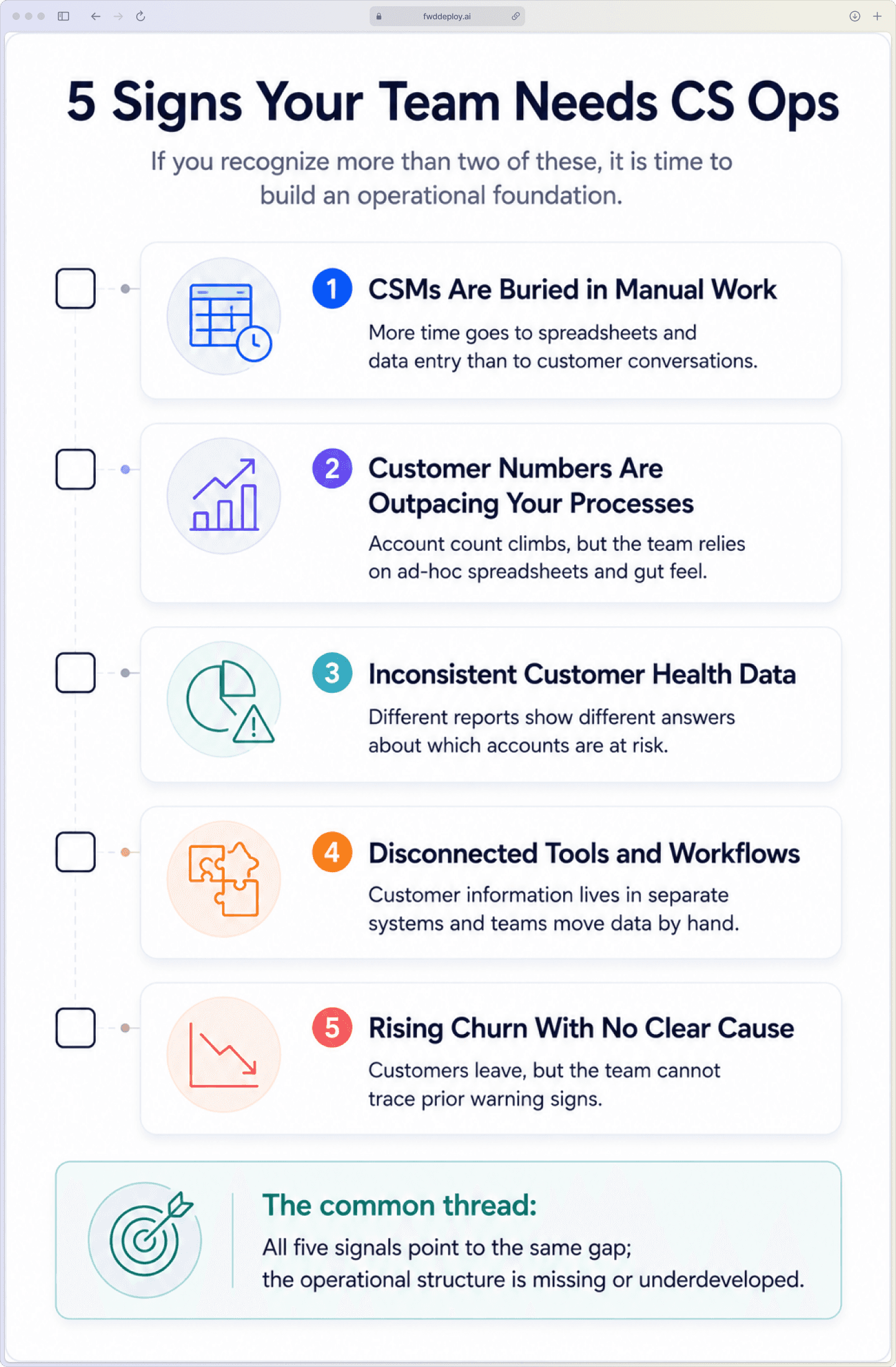
Some teams reach a point where daily work becomes harder to manage. Signs appear in reporting and workflows first.
CSMs are buried in manual work: More time goes to spreadsheets and data entry than to customer conversations.
Customer numbers growing faster than processes scale: Your account count climbs, but the team still relies on ad-hoc spreadsheets and gut feel.
Inconsistent customer health data: Different reports show different answers about which accounts are at risk.
Disconnected tools and workflows: Customer information sits in separate systems, and teams move data by hand.
Rising churn with no clear cause: Customers leave, but the team cannot trace the warning signs that came before the loss.
All these signals point to the same gap: a missing or underdeveloped operational structure.
CS Ops KPIs and metrics to track
CS Ops uses a set of metrics to measure how well the customer success function is running. These focus on retention, customer progress, account risk, and how CSM time is being used.
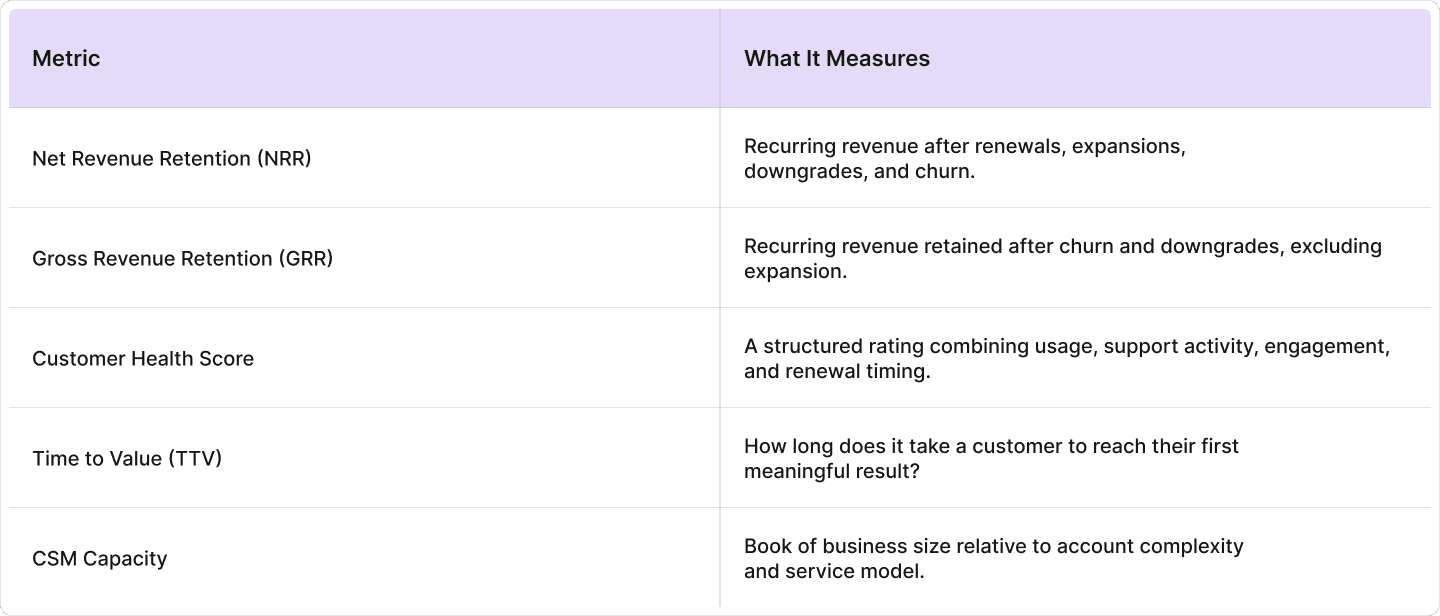
NRR and GRR answer different questions. GRR shows how well a company retains revenue. NRR shows whether customers are shrinking, flat, or growing, a key indicator of CS Ops effectiveness, with top SaaS companies achieving 120-125% NRR.
A customer health score is only useful with current inputs and clear rules. Outdated data or mixed signals create false precision.
CS Ops tech stack for modern teams
A CS Ops tech stack stores customer information, tracks activity, enables communication, measures results, and automates work.
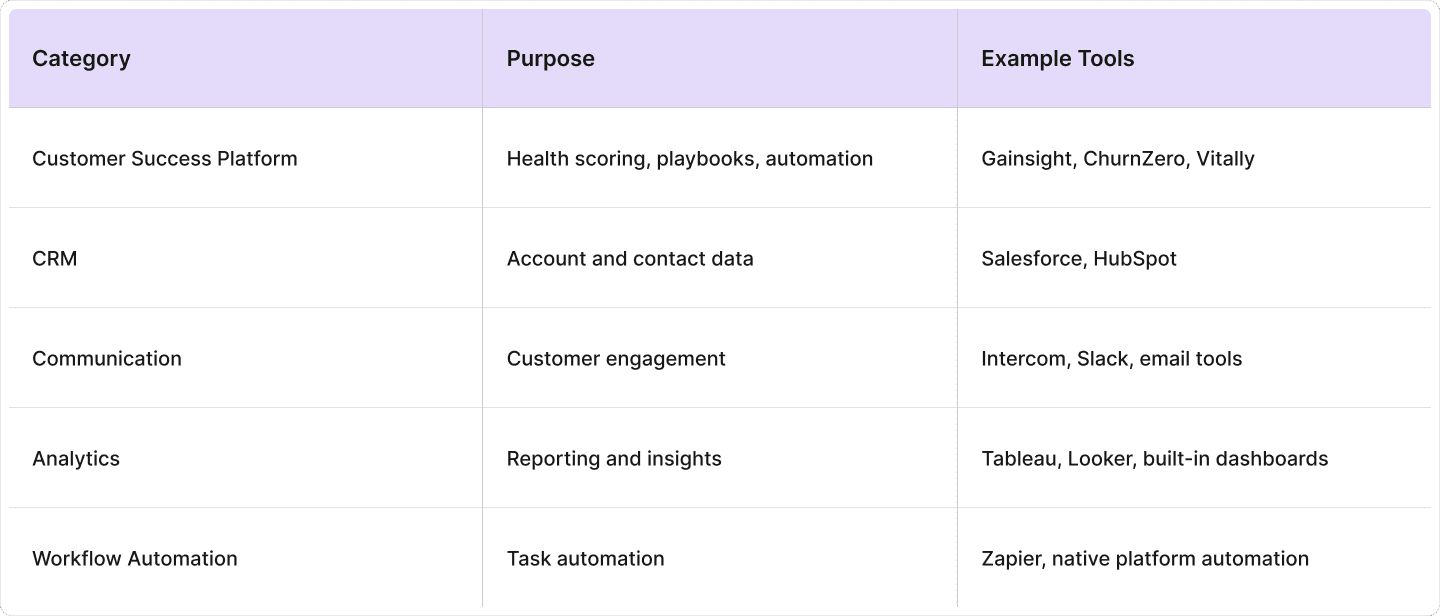
CS Ops evaluates tools by data fit, process fit, integration, and reporting quality. A tool may fail if it cannot exchange data cleanly with the CRM or support platform.
The stack often connects with support platforms. Support activity and ticket trends add context to customer health.
CS Ops vs RevOps and sales ops
CS Ops, Sales Ops, and RevOps are cousins; each tackles a different stretch of the revenue journey.
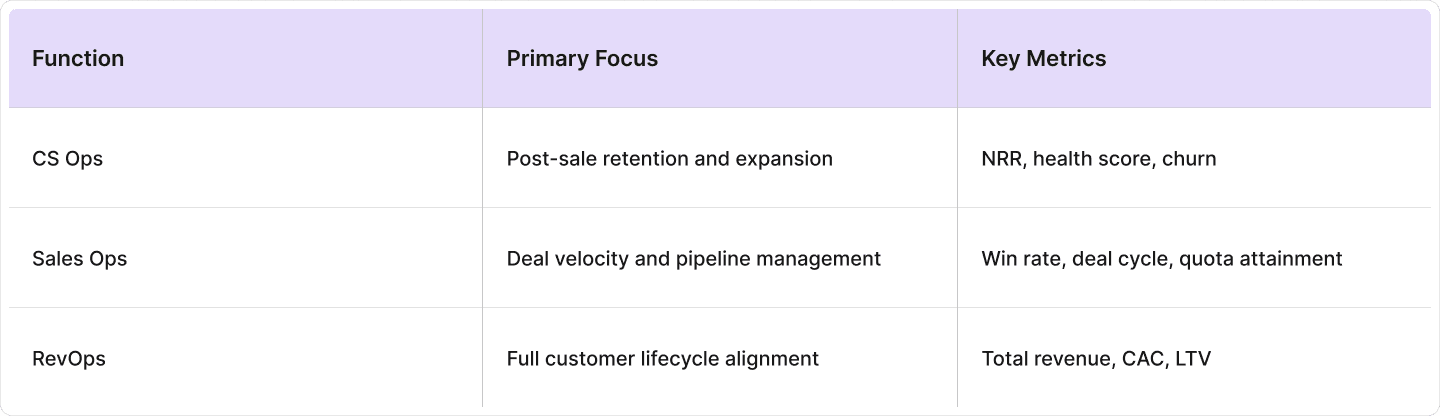
RevOps, short for Revenue Operations, covers the full revenue journey across marketing, sales, and customer success. CS Ops is narrower and focused specifically on post-sale performance. Sales Ops is narrower still, focused on sales execution.
A company may keep these functions separate when teams are large and specialized. A unified RevOps model is more common when leadership wants one shared operations structure across the full customer lifecycle, though even in that model, post-sale work typically remains a distinct area of focus.
Best practices for a high-performing CS Ops team
Building a strong CS Ops function takes more than good intentions. It requires deliberate choices about data, processes, tools, and team alignment. The practices below reflect what works when teams move from reactive firefighting to structured, scalable operations.
1. Start with data hygiene and a single source of truth
Data hygiene means customer records stay accurate, complete, and current across systems. Common issues include duplicate accounts, missing renewal dates, outdated contacts, and inconsistent field definitions.
Data governance, the structure used to keep data reliable over time, includes field definitions, ownership for updates, rules for data entry, and regular reviews for errors or gaps. Without it, dashboards and health scores reflect the mess underneath.
2. Standardize playbooks and customer journeys
Playbooks turn repeatable work into a defined process. They document what happens during onboarding, adoption reviews, renewals, escalations, and risk follow-up.
A clear customer journey map helps teams track milestones, assign ownership, and keep account experiences consistent across segments and makes internal training significantly simpler.
3. Automate low-value work with AI
Some CS tasks follow rules and do not require judgment from a CSM — sending renewal reminders, triggering alerts when health scores drop, and routing support tickets to the correct queue. When automated, these workflows can save 20 hours per CSM weekly.
AI tools and workflow automation handle parts of this work by reading signals, applying rules, and creating follow-up actions. In many teams, AI also helps summarize account activity, detect risk patterns, and flag changes in product usage.
One important caveat: automation works best when the underlying process is already clear. If the rules are inconsistent, automation usually spreads that inconsistency faster.
4. Align closely with sales and product
CS Ops connects post-sale work with what happens before and after the customer signs. Regular touchpoints with sales and product teams help share information such as implementation risks, feature requests, expansion signals, and adoption barriers.
Alignment is also about timing and ownership. A handoff works better when teams agree on when responsibility changes and what information moves with the account.
5. Measure outcomes, not activities
Activity counts show what the team did, but they do not always show whether customer outcomes improved. A high number of calls, tickets, or tasks can still coexist with weak retention or slow onboarding.
Outcome-based measurement focuses on results such as retention, expansion, product adoption, and time to value. Activity data still has a place when it explains workload or process gaps; the difference is that business outcomes remain the main reference point.
Build your CS Ops foundation with fwdDeploy
fwdDeploy helps organizations set up and improve the systems that support Customer Success Operations, tool implementation, workflow design, data migration, reporting setup, and ongoing optimization across platforms, including Freshworks, Intercom, Rocketlane, Zoom Contact Center, and more.
For teams using Freshworks, CS Ops support can connect service operations with post-sale account work, linking support signals like open tickets, escalation patterns, and resolution history directly into account health reviews.
Take our CS Ops readiness assessment to identify gaps in your current operations and discover where structured CS Ops can deliver the most impact.

Ready to fix your sales-to-CS handoff?
Stop losing context between teams. fwdDeploy builds handoff processes that run inside your CRM and CS tools, not spreadsheets.
FAQs About AI personalization
What is the difference between a CSM and a CS Ops manager?
Who does the CS Ops function typically report to?
Can small companies benefit from CS Ops, or is it only for enterprises?
What skills and experience do I need for a CS Ops role?
How does AI change the daily work of a CS Ops team?
What is the difference between CS Ops and RevOps?
How can fwdDeploy help my team set up CS Ops?
Five questions. Your work email. Under four minutes. We will tell you your maturity level, your highest-impact gap, and whether a conversation makes sense. No pitch. No demo request.
