Best AI Personalization Tools
Best AI Tools for Personalized Outbound Messaging in 2026

Written On
Jackson Junction
Posted On
Nov 4, 2025

5 Key Differences
Incident vs service request: Five critical differences
Before ITIL v3, everything landed in a single "incident" bucket. The framework later split the work into incidents and service requests to handle them more precisely, which laid the groundwork for modern ITIL practices.
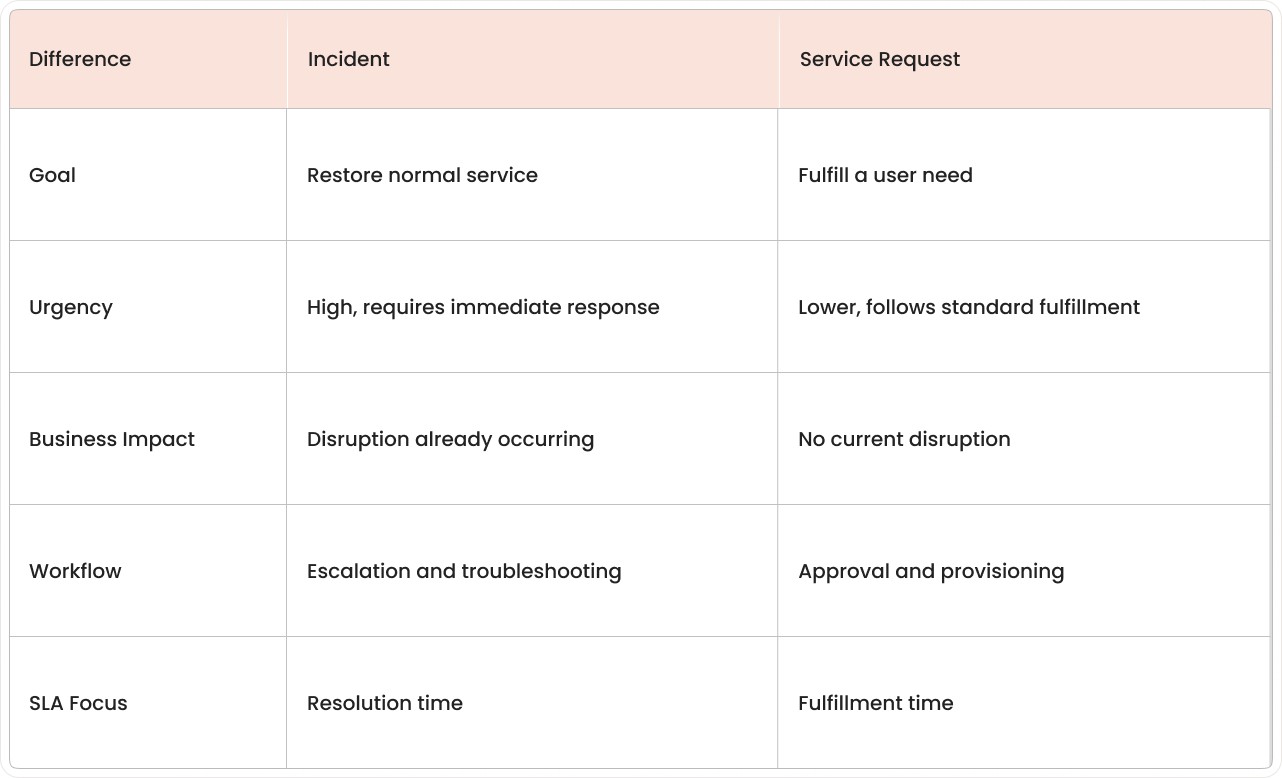
1. Goal and desired outcome
An incident focuses on restoring a service to normal operation. The outcome is a return to expected service performance, getting things back to "working normally."
A service request focuses on providing a standard service item or access. The outcome is the delivery of something requested, such as a tool, permission, or information.
2. Urgency and response time
Incidents have higher urgency because users are already affected by service interruption or reduced service quality. Response typically starts with triage to confirm impact and severity.
Service requests have lower urgency because no service failure is implied. Work often follows a standard queue because the request involves planned steps with known timeframes.
3. Business impact and risk level
Incidents carry a higher business risk because operational work is already disrupted. The impact can spread when dependent services or teams rely on the affected system, with industry data showing MTTR ranging from 0.6 to 27.5 hours depending on response effectiveness.
Service requests usually have a lower risk because fulfillment follows defined steps. Risk mainly relates to access control, licensing, or procurement rules rather than service downtime.
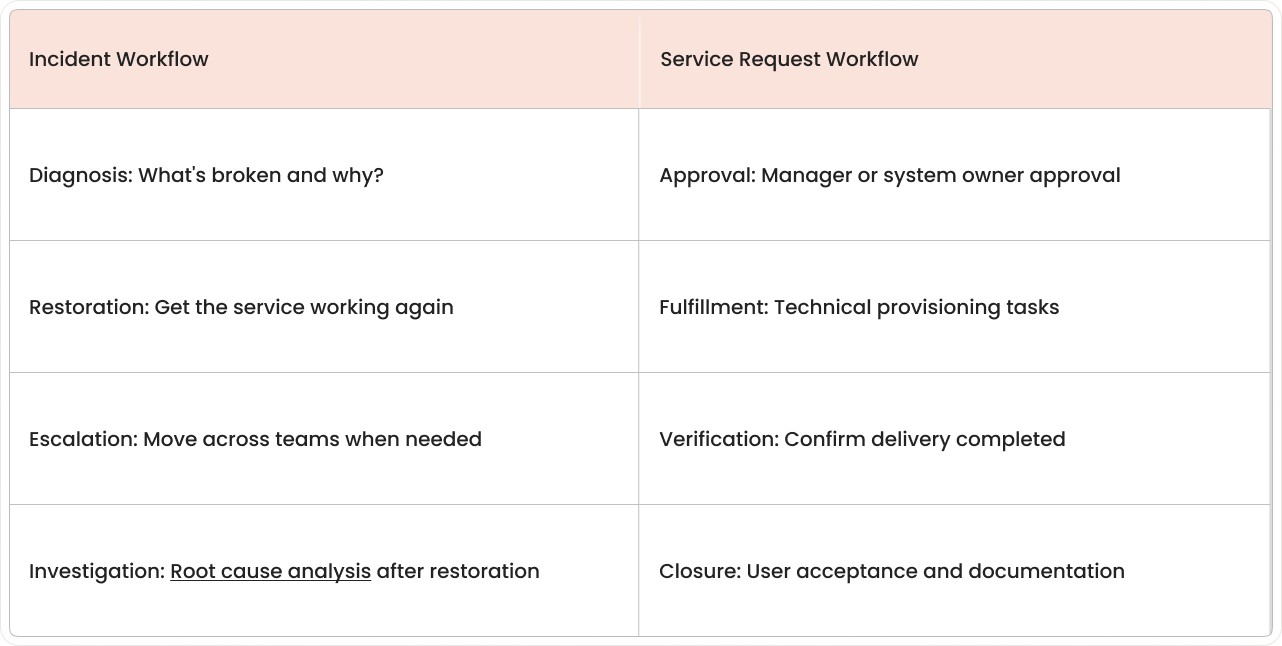
4. Workflow and escalation paths
5. SLA and priority configuration
Incident SLAs measure time-based targets such as time to first response and time to resolution. Priority settings usually depend on impact and urgency, with severity levels for major incidents that may require problem management follow-up.
Service request SLAs measure fulfillment targets such as time to complete the request. Priority often reflects request type and expected delivery windows rather than outage severity.
JSM: Manage Both
How Jira Service Management manages incidents and service requests
In a nutshell, JSM keeps the two work types in their own lanes.
It does this with separate request types that drive different forms, fields, workflows, queues, SLAs, and automations. That clean split stops password-reset noise from drowning out real outages.
In the customer portal, each request type can have its own name and questions. In the agent view, each request type can map to a different issue type and workflow, which keeps incident handling and request fulfillment distinct.

CS OPS
Ready to see how Freshservice automation transforms your Incident resolution?
Directional benchmarks based on industry data. Actual results depend on starting point and team adoption.
FAQs About AI personalization